inudgeyou – THE APPLIED BEHAVIOURAL SCIENCE CENTRE
publicationsthe applied behavioural science centre
Academic Publications & Applied Behavioural Science Resources
Explore our comprehensive collection of academic publications and practical resources on nudging, applied behavioural science, and public policy interventions. We always strive to make our work open access whenever possible, ensuring broad accessibility for both practitioners and researchers.
Join over 5,000 professionals who stay updated on the latest research and insights.
Want to get in touch?
Caroline Gundersen, Managing Director
Whether you’re just curious or already know what you’re looking for, I’d love to hear from you. Feel free to write me directly.
THE APPLIED BEHAVIOURAL SCIENCE CENTRE
Field Experiments & Applied Behavioural Science
Does reducing the serving size of beer influence how much students drink on a night out?
This randomised controlled field experiment tested whether smaller serving sizes of beer could reduce alcohol consumption among students on nights out. The study provides rare large-scale evidence on alcohol-related nudging in real social settings, showing how small design changes can impact behaviour in meaningful ways.
Reference:
Hansen, P. G., Larsen, E., Jacobsen, A.-M., Malthesen, M. S., & Schilling, M. (2024). Does reducing the serving size of beer influence how much students drink on a night out? A randomised controlled field experiment. Journal of Behavioral Economics for Policy, 8(1), 11–17.
Nudging hand hygiene compliance: A large-scale field experiment on hospital visitors
A large-scale experiment in Danish hospitals testing how nudges can increase hand hygiene compliance among visitors. The study demonstrates that simple changes in choice architecture can meaningfully improve hygiene behaviour in critical health settings.
Reference:
Hansen, P. G., Larsen, E., Modin, A., Gundersen, C., & Schilling, M. (2021). Nudging hand hygiene compliance: A large-scale field experiment on hospital visitors. Journal of Hospital Infection. https://doi.org/10.1016/j.jhin.2021.09.009
Reporting on one’s behavior: A survey experiment on the nonvalidity of self-reported COVID-19 hygiene-relevant routine behaviors
This survey experiment highlights the limits of self-reported behavioural data during the COVID-19 pandemic. The results show that participants’ reports of hygiene-related routines often diverge from actual behaviour, raising questions about the reliability of self-reports in policy design.
Reference:
Hansen, P. G., Larsen, E., & Gundersen, C. (2021). Reporting on one’s behavior: A survey experiment on the nonvalidity of self-reported COVID-19 hygiene-relevant routine behaviors. Behavioural Public Policy, 1–18. https://doi.org/10.1017/bpp.2021.13
Nudging healthy and sustainable food choices: Three field experiments using a vegetarian lunch-default
A series of field experiments testing whether making vegetarian meals the default option encourages healthier and more sustainable food choices. The results show strong effects of default options on food behaviour in real-world canteen settings.
Reference:
Hansen, P. G., Schilling, M., & Malthesen, M. S. (2019). Nudging healthy and sustainable food choices: Three field experiments using a vegetarian lunch-default as a normative signal. Journal of Public Health, 41(4), 676–683.
Apples versus brownies: A field experiment in rearranging conference buffets
This field experiment explored how rearranging the order of food items at conference buffets affected participants’ snack choices. The results show that placing healthier options first can reduce energy intake without limiting choice.
Reference:
Hansen, P. G., Skov, L. R., Jespersen, A. M., Skov, K. L., & Schmidt, K. (2016). Apples versus brownies: A field experiment in rearranging conference snacking buffets to reduce short-term energy intake. Journal of Foodservice Business Research, 19(1), 122–130.
Making healthy choices easier: Regulation versus nudging
This review compares regulatory approaches with nudging strategies in shaping healthier food choices. It highlights how nudges can complement or substitute traditional regulation, offering a more flexible approach to public health challenges.
Reference:
Hansen, P. G., Skov, L. R., & Skov, K. L. (2016). Making healthy choices easier: Regulation versus nudging. Annual Review of Public Health, 37, 237–251.
Smaller plates, less food waste: A choice architectural experiment in a self-service eating setting
A pioneering experiment showing that smaller plates in self-service dining settings reduce food waste and energy intake. This study became one of the early demonstrations of how choice architecture can support sustainable consumption.
Reference:
Schmidt, K., Skov, L. R., Jespersen, A. M., Hansen, P. G., Perez-Cueto, A., & Mikkelsen, B. E. (2013). Smaller plates, less food waste: A choice architectural experiment in a self-service eating setting. In 20th International Congress of Nutrition.
THE APPLIED BEHAVIOURAL SCIENCE CENTRE
Foundational Academic Papers & Thought Pieces
Nudging: To know ‘what works’ you need to know why it works
This article argues that it is not enough to demonstrate that nudges work — it is equally important to understand why they work. Hansen highlights the need for mechanism-based explanations to ensure that nudging remains a robust and scientifically grounded policy tool.
Reference:
Hansen, P. G. (2020). Nudging: To know ‘what works’ you need to know why it works. Journal of Behavioral Economics for Policy, 3(Special Issue), 9–11.
The concepts of nudge and nudging in behavioural public policy
This chapter provides a conceptual clarification of the terms “nudge” and “nudging” in behavioural public policy. Hansen carefully distinguishes between definitions and applications, helping to consolidate the field and improve the consistency of both research and practice.
Reference:
Hansen, P. G. (2019). The concepts of nudge and nudging in behavioural public policy. In H. Strassheim & S. Beck (Eds.), Handbook of behavioural change and public policy (pp. 63–77). Edward Elgar.
What are we forgetting?
A reflective piece that warns against overlooking the limitations and blind spots of behavioural science. Hansen calls attention to what is left out of mainstream discussions and stresses the importance of remembering the boundaries of nudging in policy and practice.
Reference:
Hansen, P. G. (2018). What are we forgetting? Behavioural Public Policy, 2(2), 190–197.
La definición de empujón de comportamiento y paternalismo libertario
A Spanish-language contribution discussing the definition of behavioural nudges and libertarian paternalism. Hansen analyses the fit between theoretical ideals and practical realities, enriching the international debate on the ethics of nudging.
Reference:
Hansen, P. G. (2017). La definición de empujón de comportamiento y paternalismo libertario: ¿La mano cabe en el guante? In Manual de economía del comportamiento (pp. 168–224).
BASIC: En diagnostisk tilgang til udviklingen af adfærdsbaseret offentlig politik
This Danish-language article introduces the BASIC framework as a diagnostic approach to developing behavioural public policy. Hansen and Schmidt outline how policymakers can categorise behavioural problems systematically and match them with suitable behavioural solutions, providing a structured alternative to ad hoc interventions.
Reference:
Hansen, P. G., & Schmidt, K. (2017). BASIC: En diagnostisk tilgang til udviklingen af adfærdsbaseret offentlig politik. Økonomi og Politik.
Rygeadfærd i BASIC-perspektiv: En case fra Københavns Lufthavne
This article (in Danish) applies the BASIC framework to smoking behaviour in Copenhagen Airports. Schmidt, Schuldt-Jensen, and Hansen demonstrate how behavioural diagnosis can be used to design and evaluate long-term interventions, offering an early example of BASIC in practice.
Reference:
Schmidt, K., Schuldt-Jensen, J., & Hansen, P. G. (2017). Rygeadfærd i BASIC-perspektiv: En case fra Københavns Lufthavne om adfærdsdiagnosticering og langtidsvirkning af adfærdsinterventioner. Økonomi og Politik.
The Definition of Nudge and Libertarian Paternalism: Does the hand fit the glove?
One of the earliest systematic attempts to define nudging and its relationship to libertarian paternalism. Hansen evaluates whether nudges can be reconciled with freedom of choice and explores the normative boundaries of behavioural interventions.
Reference:
Hansen, P. G. (2016). The definition of nudge and libertarian paternalism: Does the hand fit the glove? European Journal of Risk Regulation, 6(1), 155–174.
Nudge and the manipulation of choice: A framework for the responsible use of the nudge approach to behaviour change in public policy
This piece lays out one of the first systematic frameworks for thinking about the ethical use of nudging in public policy. Hansen and Jespersen distinguish between different types of nudges and propose criteria for when nudging can be considered a responsible tool for behaviour change. The paper is widely cited and forms a cornerstone in the debate about libertarian paternalism and public policy.
Reference:
Hansen, P. G., & Jespersen, A. M. (2013). Nudge and the manipulation of choice: A framework for the responsible use of the nudge approach to behaviour change in public policy. European Journal of Risk Regulation, 4(1), 3–28.
THE APPLIED BEHAVIOURAL SCIENCE CENTRE
The BASIC Framework
The BASIC framework is a diagnostic and ethical approach to applying behavioural insights in public policy. Developed by Pelle Guldborg Hansen and iNudgeyou in collaboration with the OECD, it guides practitioners through the entire process from identifying behavioural problems to implementing and sustaining effective interventions.
BASIC has since become a reference point for both governments and organisations worldwide seeking a structured way to apply behavioural science responsibly.
Reference:
Hansen, P. G., & OECD. (2019). Tools and ethics for applied behavioural insights: The BASIC Toolkit. OECD Publishing. https://doi.org/10.1787/9ea76a8f-en
Figure 1. The BASIC Framework. Hansen, P.G. & OECD (2019), Tools and Ethics for Applied Behavioural Insights: The BASIC Toolkit, OECD Publishing, Paris, https://doi.org/10.1787/9ea76a8f-en.
THE APPLIED BEHAVIOURAL SCIENCE CENTRE
Other Publications
What is nudging?
Hansen, P.G. (2016)
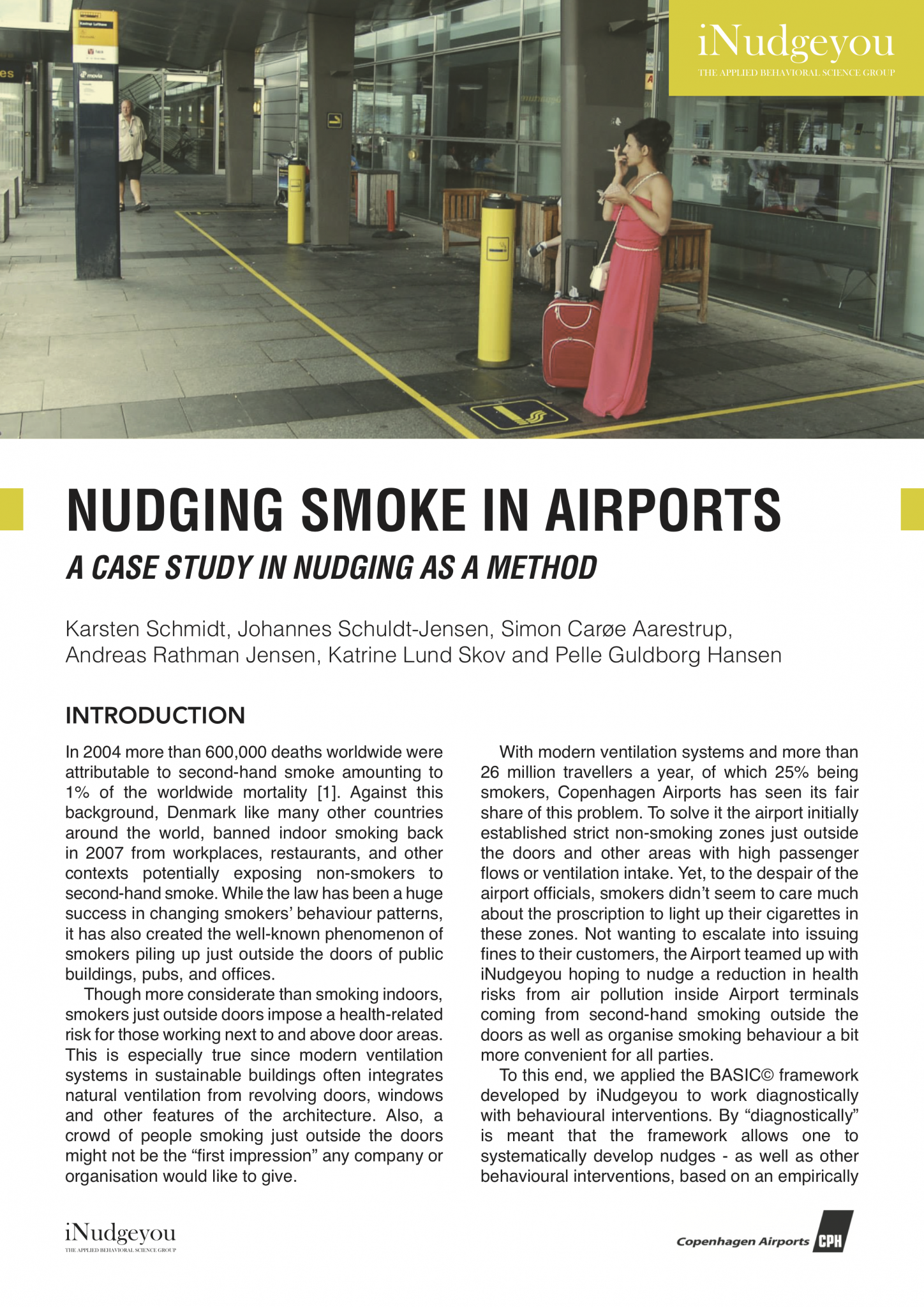
Nudging Smoke in Airports
Schmidt, K., Schuldt-Jensen, J., Aarestrup, S. C., Jensen, A. R., Skov, K. L., & Hansen, P. G. (2016)
Nudging Hospital Visitors' Hand Hygiene Compliance
Aarestrup, S. C., Moesgaard, F., & Schuldt-Jensen, J. (2016)
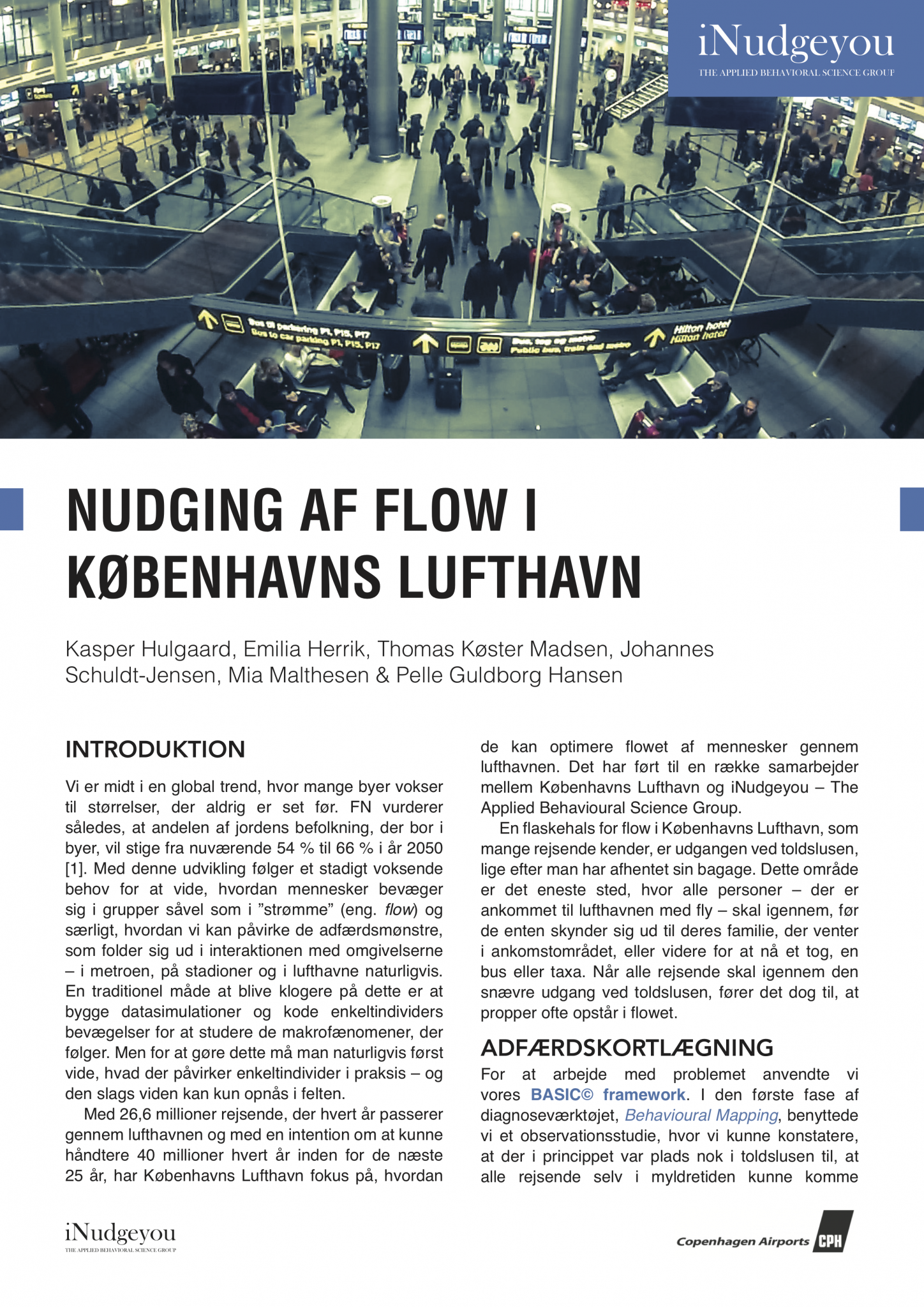
Nudging Flow in Copenhagen Airports
Hulgaard, K., Herrik, E., Madsen, T. K., Schuldt-Jensen, J., Maltesen, M., & Hansen, P. G. (2016)